China Linux development continues to mature, and Deepin Linux 25.0.10 is a clear example of how far it has come. Released by Uniontech as the latest point update to Deepin 25, this version builds on the foundation introduced in June 2025.
It does not radically reinvent the platform, but it refines it into a polished, modern desktop that signals China’s intent to remain technologically self-reliant rather than waiting on Western ecosystems.
Deepin Linux remains Uniontech’s free, community-focused desktop operating system. The gap between Deepin 23, reviewed in August 2024, and Deepin 25 was roughly ten months, and while the visual leap is not dramatic, the experience feels more cohesive.
The system still uses the Deepin Desktop Environment (DDE), now labeled DDE 7. Changes are evolutionary rather than disruptive: the Settings application has been reorganized, the file manager redesigned, and overall navigation feels cleaner without breaking familiarity for existing users.
Desktop Design and Display Technology
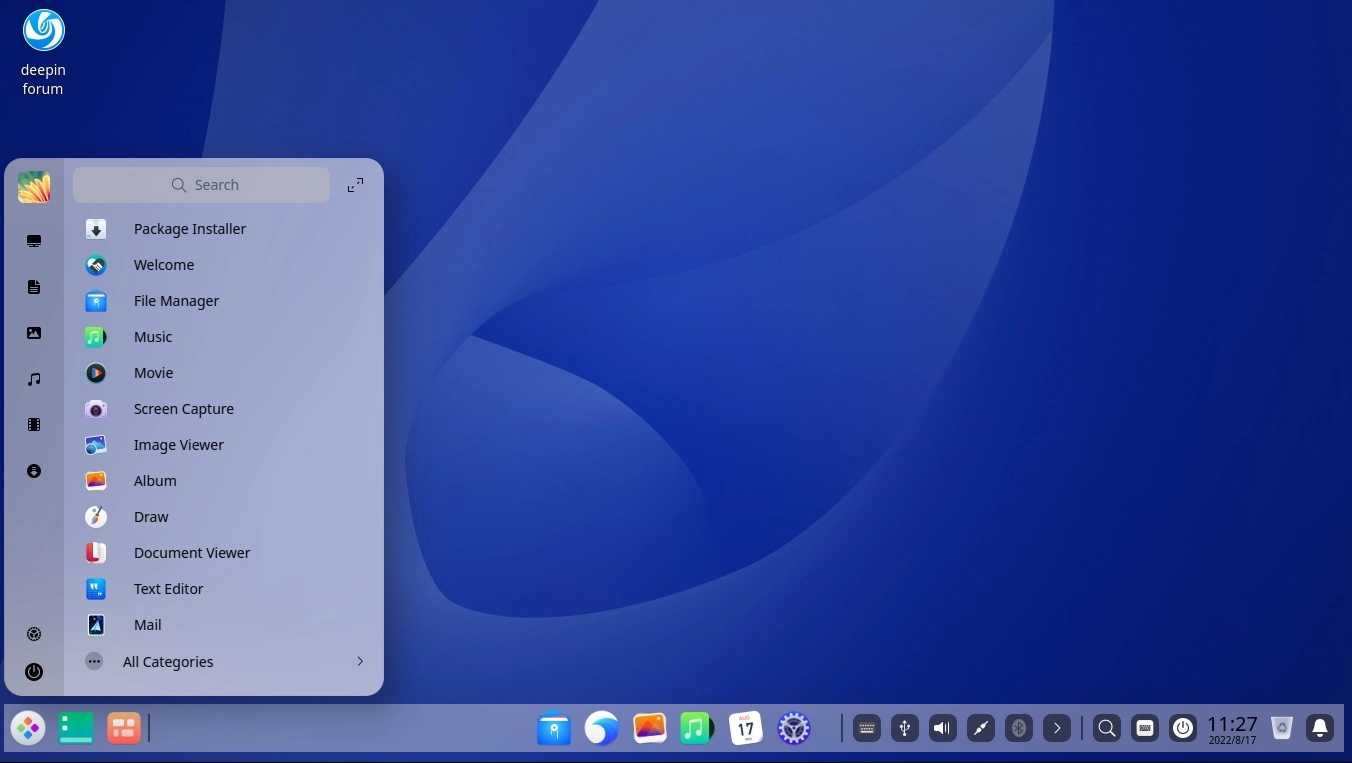
Deepin OS (Source: WikiPedia)
The Deepin desktop continues to resemble Windows 11 in layout, with centered application launchers and a taskbar designed to feel instantly familiar. A notable addition is the reserved position for Uniontech’s large language model assistant, UOS AI, which sits prominently on the dock.
Although Uniontech is developing a new Wayland compositor called Treeland, this release still relies on X11. Treeland uses the Qt toolkit, aligning it with KDE and LXQt, but remains a technology preview rather than a production-ready option. For now, Deepin Linux prioritizes stability over experimentation.
Hardware support is mixed. The operating system is not lightweight, but its requirements are reasonable: around 6.7 GB of disk space and roughly 1 GB of RAM. Official guidance for x86-64 systems recommends 8 GB of RAM, a 1920×1080 display, and at least 64 GB of storage. In testing, the live environment ran smoothly on a newer Dell XPS 13 but showed issues on older hardware, such as a ThinkPad T420, and within VMware Workstation.
Built-In AI: Present, Prominent, and Debatable
Uniontech has clearly decided that built-in AI is now part of the desktop baseline. UOS AI is integrated directly into the interface. On first launch, users must confirm they are over 18 and acknowledge that English-language support may be limited. Once inside, the assistant presents a simple text box for queries.
When asked what Linux distribution Deepin 25 is based on, the AI produced lengthy responses emphasizing that its training data ended in 2023 and that it could not access the web. It repeatedly stated that earlier versions of Deepin were based on Debian but avoided speculation beyond its training cutoff. For Chinese-language users, the AI integration is more compelling: a welcome video highlights features such as document translation, text summarization, explanations, and local file search.
Whether this technology is transformative remains open to debate, but its inclusion is deliberate. In 2026, AI integration has become part of the sales pitch, even within Chinese Linux distributions, and Deepin Linux embraces that reality without hesitation.
System Architecture and Software Management
Deepin 25 introduces what Uniontech calls a “Solid” layout, a partially immutable system design based on OSTree tooling. Core directories such as /bin, /lib, /lib64, /sbin, and /usr are mounted read-only, even for the root user. Unlike Red Hat’s fully immutable approach, this system does not provide whole-OS snapshots, and immutability can be disabled or re-enabled with specific commands. The design echoes techniques seen in openSUSE in 2024 rather than adopting a fully locked-down model.
Software packaging avoids the Flatpak versus Snap debate entirely. Instead, Deepin Linux uses Uniontech’s cross-platform system called Linglong, also known as Linyaps. A default installation includes around 20 Linyaps packages, covering core tools such as the email client and calculator.
A Sinocentric but Capable Desktop
English language support is less visible than in earlier releases. The initial boot screen appears in Chinese, with “English” standing out as the only English word. US English keyboard layouts are available, but UK English is not; there is only a region setting to ensure sensible date formatting.
Deepin Linux is pragmatic rather than experimental. There is no choice of desktop environment and no internal debate over competing packaging formats. It borrows technology from Debian and Red Hat while avoiding the heavy restrictions common in Western immutable distributions. The result is a system that looks modern, works reliably, and feels tailored to domestic needs.
As a showcase of Chinese desktop Linux, Deepin Linux 25.0.10 succeeds. It demonstrates how China Linux projects have adapted Western open-source foundations to build operating systems with their own desktops, tools, applications, and even processor support. It does not need to outperform global competitors. It only needs to be good enough to run reliably on domestic hardware—and by that measure, Deepin Linux is already there.


0 Comments